The Fighter’s Mind, Inside the Mental Game

If any reader has ever thought “fighting” to be some barbaric competitive outlet that has no bearing outside of brawn a read of The Fighter’s Mind, Inside the Mental Game will offer enlightening insight.

Author Sam Sheridan shares the universality in the simple line, “that everyone is fighting something,” and in this book addresses what some consider to be a cliche tag, ‘”Fighting is fifty percent mental”‘ (preface). Throughout Sam’s travels he interviews great fighters from various backgrounds and styles setting out to answer many questions from many minds. Among those there is one mind familiar to many in an unrecognized way.

Josh Waitzkin proves to be a mountain of mental development within the ring. Searching for Bobby Fischer is a film adapted from “a book that Josh’s ‘Pop’ had written about Josh’s early chess career” (pg. 184). As an early chess master both his mind and his reputation were no strangers to fame. As an author himself, Josh has written both Attacking Chess and The Art of Learning (both of which are available directly from the author’s website, here) the later of which received praise from numerous inspirational writers including Deepak Chopra. It is within this chapter that Sheridan truly taps the undeniable truth of the psychological traps and pitfalls to which the contenders are subject.

Queries stretch along lines of heroes, unmatched rivals and personal inspirations. What it takes to be one of those heroes is answered in part by esteemed trainers such as Freddie Roach and Greg Jackson.

How these men reach heightened planes of performance is unveiled through their own given circumstance. These men accomplish amazing physical feats such as is with the case of “Captain America” Randy Couture whose body has become more of a championed machine. During strenuous activity our bodies produce higher levels of lactic acid resulting in what we experience as fatigue. After years of vigorous conditioning Randy’s body does not.

The Fighter's Mind, Inside the Mental Game

Click image to buy The Fighter's Mind

Where the fight takes place stretches over continents and transcends both the mind and body. Later in the book, we see a list from Applied Sport Psychology containing qualities of “peak performance” (pg. 255):

  • Loss of fear–no fear of failure
  • No thinking of performance
  • Total immersion in activity
  • Narrow focus of attention
  • Effortless performance–not forcing it
  • Feeling of being in complete control
  • Time/Space disorientation (usually showed down)
  • Universe perceived to be integrated and unified
  • Unique, temporary, involuntary experience
Sam relates these bullets to the Zen of martial arts.

The who contained within the book includes well-known names of accomplished fighters including Rory Markham, Mark DellaGrotte,  Frank Shamrock, Andre Ward, Dan Gable and Renzo Gracie.

However many questions are answered inside of this text the why is the sought after reason which remains most elusive. During an interview with Jon Stewart, The Daily Show, Sam is asked why he crossed the boundary and traveled to Thailand to fight and replies with a less than articulate response (which he acknowledges nearing the close of the book) and follows with a comment about fighting being an “art,” to which Jon lays his exquisite wit.

There is much to be said about the passion driving performance across the board, going beyond fighting, beyond running, beyond theater. Dually personal and widely relative this read, while not providing the backing to qualify fighting as an art, does allow answers for the who, what, when, where and how of the mind’s journey while faced with the life and death bouts that extend far beyond the category of sport.

In summation, to quote a friend, the message anyone can find resonate here is that, “To be really really good at anything takes dedication and a lot of hard work.”

Sam Sheridan is also the author of A Fighter’s Heart.

The Emerald City (EC)

This is the place where I hang my morning jacket.

Contrary to popular belief from Wizard of Oz fanatics, Emerald City is actually a real place here in Chicago. I know because I’ve become a “regular,” over the past three years and have been delighted to see the space get better and brighter as a privately owned business. Yeah, Starbucks is very good; we all know that and most of us fast-track through the place to get our urban-style morning caffeine fix. However, that cookie cutter corporate formula calls for an escape into something more personable, unique and outside of assimilated success (in other words, more “real”).

So, I know I’m bias.  This isn’t a review, necessarily.  Let us call it a comparative rant with some shameless plugs.

I like coffee, tea, sweet snacks and the EC vs. the SB for these three is a pretty even call. Now, let’s weigh in the meat, literally. Who can beat simple toast, eggs, superb hash rounds with bacon and or sausage cooked right there behind the bar a little to the left of the single register. Breakfast is available until 1:00p.m. which is great for me, but if I miss that I know I can have an excellent lunch. The sandwiches offered at most chain branches are quick-fix ready to eat pre-packaged choke downers (a little harsh but mostly true) while this high-quality emerald jewel offers tasty, fresh ingredients and some of the better sandwiches I’ve tried in the city. I love Emmy’s Club– chicken, bacon, apple, peach preserves, lettuce, tomato on tomato basil, $6.99 includes chips and drink (there’s my shameless menu plug). For those of the liquid diet persuasion the iced coffee is fantastic but I’m more of an apple-cider kind of guy (shameless drink plug, check). Lastly, how many of you have had trouble hanging up a poster or show advertisement at the clusters? “Oh, we can’t do that,” or “only if it’s non-profit,” and “I’ll have to clear it through the home office,” are ongoing responses I encounter and yes I understand the importance of protecting a branded identity, but at the same time, … really? Not only does the Emerald City always hang up advertisements for neighborhood events they actually host one of their own open mic nights.

Every Friday night at 8:00p.m., poets, artists, writers, rappers, singers and comedians gather in the intimate space to try out new material, rebirth some old warhorses or simply get up in front of people to speak for the first time. Incidentally, I’m MC at the EC (told you I am bias) proving that it couldn’t be more laid back and off-the-cuff friendly (big shameless event plug over). So, community folk of Uptown, Buena Park and Wrigleyville give a new place a try, broaden your morning coffee horizons and meet a favorite friendly staff always ready to make your morning gleam in the green.

And to all my friends and readers outside of the area (that includes all you lovely Tennessee folk) I say, “Where is your Emerald City?”

Emerald City is located at 3938 N Sheridan,

convenient to the Sheridan Red Line

Open Mic Nights are Fridays at 8:00p.m., BYOB:

http://www.facebook.com/event.php?eid=217430434935118

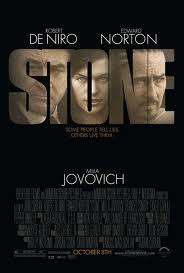
Stone


Stone with Robert Deniro, Milla Jovovich and Edward Norton

Edward Norton and Milla Jovovich in Stone

Stone leaves the now home audience immersed discussing pseudo-philosophies, the placebo effect, moral responsibility versus guilt and the validity of a true character change.

Jack Mabry (Robert Deniro, Casino, Taxi Driver) reviews inmates terms and behaviors deeming them either worthy of early release or subject to full term. One such case revolves around Gerald “Stone” Creeson (Eward Norton, Fight Club) convicted as accessory to the murder of his grandparents in addition to the following arson. Wife to Stone, the “dime” atheist vixen Lucetta Creeson (Milla Jovavich, The Fifth Element) plays temptress on the outside luring a suspect Jack into her influential disarming prowess. Nearing the end of his incarceration Stone experiences a dark epiphany as witness to a needless murder afterwhich he seeks new knowledge and guidance for renewing his character; he finds transforming truth which leaves both his reviewing cop and promiscuous partner at a loss.

Zukangor, a fictitious eastern philosophy (found in easy to read pamphlet form) inspires this inmate to seek enlightenment through first “the sound,” which is described to next evolve into an enveloping light. While most note that people don’t change overnight, the shift remains evident in Norton’s portrayel of the character’s new found guiltless disposition. Attempting to share this disovered inner harmony with Jack and Lucetta only leads to unintended frustration and conflict. To compact confrontation, the same pamphlet later finds its way into the hands of Jack’s wife, Madylyn (Frances Conroy, Six Feet Under). Sharing with her husband on the porch, she describes the journey of spiritual development within the faith as beginning in an early life form (from smaller primitive life into larger animals), slowly earning our human state while all the time paying for the sins of our past lives. Although she doesn’t subsribe this doctrine undoubtedly serves as a fiery catalyst for her future. Do these new reflections lead these two characters into fresh frames of life or is it simply convenient self-trickery?

Stone with Robert Deniro, Milla Jovovich and Edward Norton

Click here to buy Stone

What’s more daunting than the haunting truths of Stone’s past is the brilliantly transitioned opening scene between Jack and Madylyn where a child becomes bargained bait for the parents’ future dissolving into the present day couple seated in church. Mixed throughout the film are soundscapes of continuous judgement, religious talk radio and fear evoking news reports which pair the internal maddening monologue of the old man approaching retirement.

Daring departures sometimes falter but not in this instance. Jovavich proves the perfect player balancing pseudo-innocence with fearless frivolity.  While often viewed as the super powered action heroine, this actress flaunts verile versatility and an unwavering gaze of paralyzing seduction. Do not dismiss such a complimentary critique as simply another assimilated, typical lusty role. A subtle madness lies behind those eyes.

While contrary to some of the earlier, established reviews (as from Rex Reed of the New York Observer) which bash the premise and the performers left and right a second opinion for film is always sound; a good movie entertains while either educating or inspiring intellectual conversation and to end in an agreeing last line quote from Reed, “Wait for the DVD,” it is here. This rainy day selection is a quick Red Box away.

Stone

running time 105 min., written by Angus MacLachlan, directed by John Curren