The Life and Death of Planet Earth

In observance of the recent passing holidays and emergence of spring my twelfth pick focuses on cycles, indeed the greatest of our globe,  The Life and Death of Planet Earth: how the new science of astrobiology charts the ultimate fate of our world.

Astrobiology is a relatively new science emerging as a culmination of astronomy, biology and paleontology and offers a predictive view into the future inevitable demise of our present planet. Yet, eschatologically speaking, what is the significance of data that does not include the walk of our species?  In other words, when our world is engulfed by the ever expanding sun the human race will have either suffered earlier extinction or ventured into a a galactic pursuit of new livable terrain.

Consider the batteries in your mouse. Sometimes our intelligent computers will alert us with a “low battery” message. This allows for a new mark on the shopping list, “pick up batteries,” and ultimately for you the reader to continue navigating your way through this article and onward towards an abundance of web information. Given the significant stretch of planetary life, Earth’s “low battery” indication may have already lit. Compressing 4.6 billion years of earthly existence into the face of a clock leaves Homo sapiens marking only the “last two seconds of [a] twenty-four-hour day” (pg. 14). Accounting for only our recorded history of civilization those seconds are even further reduced.

As the book moves through the eons, eras and periods it visits evidence of the stratigraphic record, the harmony of our encircling satellite and a delicate axis tilt, past the explosions of life as presented in the Burgess Shale (pg. 122) on into shorter days, returning super continents, uninhabitable conditions and a fascinating chapter dedicated to the loss of oceans. To anthropomorphize, visualize the planet as a living organism not unlike a common individual cell, life’s biochemical sphere; now relate the emanating energy field or human aura if you will to the images captured by “‘Carruther’s camera'” from Apollo 16 that “provided stunning images, which show Earth to be surrounded by a ghostly halo of fluorescing hydrogen gas” (pg. 136).  While this ring extends only “a few tens of kilometers before it is lost in the blackness of space,” observation within the ultraviolet range reveals a strange “Lyman alpha aura [extending] tens of thousands of kilometers outward, a sphere of escaping gas much larger than the Earth itself” (pg. 136). To those less inclined to hire images on ones own accord a highly recognizable introduction from Universal Pictures proves picturesque.
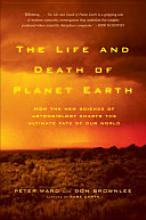
Click here to buy The Life and Death of Planet Earth

As escaping elements and gravitating atoms have, do and continue to leave us I am reminded of one final quote highly relevant to the subject at hand. “Yet even today, less than 1 percent of the original hydrogen of cosmos–the simplest atom–has been converted to more complex elements. The atoms of your body–and indeed, of our world–are products of evolutionary recycling in the cosmos” (pg. 26).

All cosmos aside, at the local level the book contains references to The University of Chicago’s Jack Sepkoski and Chicago Paleontologist David Raup and their respected contributions to the argument of diversification and introduction of the term “background extinction rates” (pgs. 41, 45).

To say the long and short, it is a good science read.

Theater as Therapy

We all have something to say, a story to tell.  Where and how does one find an outlet to feel safe, free and liberated?

This past April 17th (last Sunday [my 30th birthday]) I completed what has proven to be the most difficult performance of my life, thus far.  Being only a workshop preview presentation containing twenty minutes of my first full-length one man show I had little anxiety until minutes before going before my audience.  Realizing another first, before me sat around twenty-five of my dearest Chicago friends along with three supportive representatives of Victory Gardens.  While many of these friends are rather close only one of them possessed prior knowledge of my abusive childhood.  Two minutes into my piece my mouth had gone as dry as a sour persimmon and twice over I consider stopping and announcing I wasn’t going to continue.  However, I barreled forward, rushing, forgetting the basics of projection, spilling over my articulators, going up, leaving out lines simply trying to keep up with my adrenaline level and racing pulse.  How did I wind up here?

A week of confession, therapy and self-healing culminating in a public performance on one of the most beautiful stages in the city with nine other exceedingly honest and loving individuals succinctly recounts my week with GLBT performance artist Tim Miller and how I wound up at thirty years old.

Fewer things in this world have made me feel as blessed as this experience.  Let’s go back in time to the first week of March.  For one week this eclectic cast meets and begins with checking in to see where we stand in our bodies, considering the early parts of the week and the day leading up to our walking into the building. We share.  Depending on the day we next engage in a series of exercises hiring images, discovering the space, creating a portrait, feeling comfortable in our skins and using the power of gesture all of which lend to finding the message and text within our core desiring freedom.  Many memories and powerful emotions surfaced for us all.

Landscapes of grey painted the mixed dark antics and playful light wits.  Speaking of  wit, what savvy spilled forth from Deb during the “pussy wants to fuck,” speech!  Remembering tiny details and large spaces I think of Scott’s piece and the potent, visceral peeling fingernail and his thoughts of manhood; next, I’m lost in Stephanie’s dark playhouse of a mad childhood.  Heather brought us into illuminating light with the continuous “ifs,” eventually thrown back her mother’s way, “If you Mom!”  Dennis dealt with inundating truths leaving him unable to stand alone and Brittany’s rattling teeth ticked away at the silence of secrets.  Kendall turned towards a personal history with courageous return to the stage embracing the ambivalence of solitude, “I thought it was the clothes.”  And in a statuesque soliloquy leaving forever reminiscent memories of the Sears Tower itself Kris gave us a gift of enigmatic “poster child” poetry contained within pictures within pictures.

Without these other nine (including Tim) pioneers of the art I may not have gathered the courage to look my step-father in the face or to go head-on against a promiscuous past and tell the needed tale of truth.  Following the culmination of our parts on that Sunday, March 6th evening I was reminded of the necessity for fearless, humble shamelessness.  The stories were over and a complete stranger and young friend of Kris tapped me on the shoulder.  I turned around to see her looking at me with her hands out palms up.  I instinctively placed my palms on hers.  Looking at me with eyes of water she said, “Thank you.”  We embraced.  Standing, holding and sobbing with a complete stranger that I immediately knew I kept repeating, “I know.  I know,” for I knew she knew and words prove meaningless in front of such truths.

This is how I found myself in the midst of a theatrical confession.  Childhood trauma travels forever miles in our adult shoes but no one need think they face it alone. Self-inflicted mental anguish regarding sexual identities conflicting with religious dogmas and rubbed raw by social stigmas has gone on long enough in our country. More people who face their shame, own their guilt and share their secrets equals more people carrying the pricey baggage hand in hand; I dream of the day when we can drop it all together.

Until then, I will venture into my story but make a promise to temper the shadow side with rays of radiance and flights of fancy freedom.  And for those who are willing to go with me on this journey, look for my invitation to take your seats.

Source Code

Source Code provides for a realization of entertainment that merits repeating.

Anyone who frequents the movies may find themselves stumped by a paralyzing plethora of sequels for the summer line-up of silver screen cinema.  Thankfully, like a man emerging from a cold, metallic chamber taking in a much-needed breath, writer Ben Ripley lays out a script of clock breaking originality.

An inbound Chicago train contains a bomb which, in one reality, has exploded. Believed to be the first of many attacks on our fair city, one man holds the  needed neuro-know-how.

Soldier Colter Stevens (Jake Gyllenhaal, Brokeback Mountain, 2005 ) awakes to find himself at the core of an experimental homeland protection program where the subject undergoes “time reassignment,” for a duration of eight minutes in order to recover data to avert future atrocious acts.  Proving a jarring task for a performer, Jake delivers a highly believable sense of initial disorientation traveling through a well-sustained arc of discovery into a grounded sense of his transubstantiated self.

While having to cope with blinding bursts hurling Stevens back into the loop, he faces a mirror to see a face not his own.  He inhabits another man’s body, one of similar physiological traits.   Cycling through suspects while retrieving bits of data our Quantum Leap-like soldier is guided by the face of Coleen Goodwin (Vera FarmigaUp in the Air, 2009) who must eventually make a choice of epic moral proportions concerning the duty and duration for the future program, the weight of which lands within the full circle journey of dueling dualities and parallel worlds.

coming soon to DVD Source Code

Click here to pre-order Source Code

Ironically, during always approaching chaos the chance for love at first sight remains on continuously play as our protagonist falls for Christina Warren (Michelle MonaghanGone Baby Gone, 2007) only to see her die time and time again.  Compelled and driven towards absolute truth Colter mangles his way past repetition and panning paranoia through multi-dimensional plot lines racing to the hub of the downtown Chicago transit heart.

Among others within the intimate cast of characters are Dr. Rutledge (Jeffrey Wright, Casino Royale, 2006) the man in charge of the current version of the project and Derek Frost (Michael Arden, The Good Shepherd, 2006).

Finally, to those bent towards a disposition where nothing can be original, only rediscovered and rehashed, I simply quote Colter’s character, “It’s the same train but it’s different.”

Source Code is a refreshing flash of timely thought-provoking escapism directed by Duncan Jones (Moon, 2009).