The Life and Death of Planet Earth

In observance of the recent passing holidays and emergence of spring my twelfth pick focuses on cycles, indeed the greatest of our globe,  The Life and Death of Planet Earth: how the new science of astrobiology charts the ultimate fate of our world.

Astrobiology is a relatively new science emerging as a culmination of astronomy, biology and paleontology and offers a predictive view into the future inevitable demise of our present planet. Yet, eschatologically speaking, what is the significance of data that does not include the walk of our species?  In other words, when our world is engulfed by the ever expanding sun the human race will have either suffered earlier extinction or ventured into a a galactic pursuit of new livable terrain.

Consider the batteries in your mouse. Sometimes our intelligent computers will alert us with a “low battery” message. This allows for a new mark on the shopping list, “pick up batteries,” and ultimately for you the reader to continue navigating your way through this article and onward towards an abundance of web information. Given the significant stretch of planetary life, Earth’s “low battery” indication may have already lit. Compressing 4.6 billion years of earthly existence into the face of a clock leaves Homo sapiens marking only the “last two seconds of [a] twenty-four-hour day” (pg. 14). Accounting for only our recorded history of civilization those seconds are even further reduced.

As the book moves through the eons, eras and periods it visits evidence of the stratigraphic record, the harmony of our encircling satellite and a delicate axis tilt, past the explosions of life as presented in the Burgess Shale (pg. 122) on into shorter days, returning super continents, uninhabitable conditions and a fascinating chapter dedicated to the loss of oceans. To anthropomorphize, visualize the planet as a living organism not unlike a common individual cell, life’s biochemical sphere; now relate the emanating energy field or human aura if you will to the images captured by “‘Carruther’s camera'” from Apollo 16 that “provided stunning images, which show Earth to be surrounded by a ghostly halo of fluorescing hydrogen gas” (pg. 136).  While this ring extends only “a few tens of kilometers before it is lost in the blackness of space,” observation within the ultraviolet range reveals a strange “Lyman alpha aura [extending] tens of thousands of kilometers outward, a sphere of escaping gas much larger than the Earth itself” (pg. 136). To those less inclined to hire images on ones own accord a highly recognizable introduction from Universal Pictures proves picturesque.
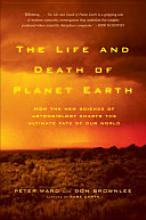
Click here to buy The Life and Death of Planet Earth

As escaping elements and gravitating atoms have, do and continue to leave us I am reminded of one final quote highly relevant to the subject at hand. “Yet even today, less than 1 percent of the original hydrogen of cosmos–the simplest atom–has been converted to more complex elements. The atoms of your body–and indeed, of our world–are products of evolutionary recycling in the cosmos” (pg. 26).

All cosmos aside, at the local level the book contains references to The University of Chicago’s Jack Sepkoski and Chicago Paleontologist David Raup and their respected contributions to the argument of diversification and introduction of the term “background extinction rates” (pgs. 41, 45).

To say the long and short, it is a good science read.

The Lost Card

Many from Memphis know the actor in me and others from the Knoxville, TN area know the Musician in me and here in Chicago friends and acquaintances dub me the comedian or “the book guy.”  Jack of many trades is a term I’ve come to love.

Working in a book store for over three years has not only allowed for my vastly increased knowledge regarding contemporary literature but also for my ability to review said literature in succinct fashion in a program I’ve so named, “Nick’s Picks.”  Persnickety is a word that comes to mind considering the limited space allotted for these two to three sentence critiques.  Ever constant as I remain to self-edit these selections, occasionally an error of spelling or syntax or worse slips through the cracks.  One such crack involved The Lost Gate by highly recognized science-fiction writer, Orson Scott Card.  Following formula (in our humble book store), I always write the title at the top of the shelf label insert.  In this instance rather than writing, The Lost Gate, it read The Lost Card. This escaped my attention for a week or so until I swiped it from the shelf.

During the next week I chose the selection to be recommended at length as my weekly submission to local blog Uptown Update (see Nick’s Picks).  The response got my attention.  “After hearing what a homophobe OSC is, I will never buy another one of his books.”  Supposing this could simply be conjecture or damaging rumor I did a quick google search and found many heated arguments against OSC’s views on marriage equality many of which reference his article submissions to The Mormon Times. Essentially, his stance regarding same-sex marriage is that such an allowance for this equality robs heterosexual couples of their societal privilege and ultimately damages the sacrosanct integrity of this divine partnership.  His support of Prop 8 and praise for the youth who align with this support flesh out his opposition.

I am a proponent for marriage equality; however, details regarding my position on the matter remain for subsequent posts.  I come now to the dilemma.  Given the aforementioned book was my first reading of the author’s works, do I stand behind my recommendation or allow new insight and feelings to contradict my already published opinion?  Illumination should always temper ignorance.  Yet learning such news about this author doesn’t change the fact that it is, in fact, a good book.  This being said, I’ve confessed my ignorance.  While I could claim this new knowledge changed my opinion of the author I simply had no opinion of the author other than hearing tale of his being an ace among science-fictionists.

Sharing this conversations with many friends elicited the same state of surprise that such an imaginative author could subscribe to such a nebulous view.  Clear though it may seem to those aligning answers to a set of dogmatic principles, the institution of marriage is one that will evolve just as it has and just as we have.  Those who consider their way of life under attack need think again, for identifying a marriage to be solely between a man and a woman through an ordained sect for purpose of procreation sounds as robotic as a view from the next great dystopian novel.  The heart is missing.

In close I know Orson Scott Card from this one work as an amazing writer, an “Ace,” in a deck of many face cards.  And while such a figure may trump many hands it all depends on what you’re playing for in the game of Euchre the Jacks are the bowers.